
Notes / Methodology
Best Tools for WhatsApp Marketing Automation for Small Businesses in 2026
You are paying for a WhatsApp tool that still makes you reply to every message by hand. Many platforms bury their best automation behind higher tiers, so small teams end up doing manual work anyway. That is usually the moment people start comparing alternatives.
This guide breaks down what small businesses should check before switching: pricing, team size, and integration needs. Then it ranks eight tools, starting with Com.bot, an AI platform with direct WhatsApp Business API access, so you can pick the right fit fast.
What to Look For in WhatsApp Marketing Automation Tools for Small Businesses
Selecting a WhatsApp Marketing Automation tool for a small business in 2026 requires balancing ease of use, cost, and the ability to scale without adding headcount. The right platform should feel like an extra team member, not another system to manage. Before comparing vendors, it helps to build a short checklist of non-negotiable criteria.
Use the following factors as a scorecard. A tool that fails on API compliance or opt-in management is a liability, no matter how attractive the price looks.
- No-code bot builder: A visual, drag-and-drop flow editor lets non-technical staff launch and edit Chatbots without developer help. Look for branching logic, delays, and the ability to pause a flow for human takeover.
- WhatsApp Business API compliance: The vendor should be an approved provider or work through one, support Message Templates, and handle quality ratings and messaging limits correctly.
- Broadcast messaging limits: Confirm how the tool manages template categories, per-conversation pricing, and rate limits so campaigns do not get blocked.
- CRM integration: Native or webhook-based connections to your CRM keep contact records, tags, and conversation history in sync for Customer Segmentation and Sales Funnel tracking.
- Pricing fit for small budgets: Prefer transparent plans that scale with message volume or contacts, avoid long lock-ins, and check whether per-conversation fees are passed through clearly.
Beyond the basics, evaluate the automation features that drive day-to-day results. Drip Campaigns and Keyword Triggers let you nurture leads and respond instantly when someone types a word like "price" or "book." Auto-replies handle after-hours questions, while Interactive Buttons, List Messages, and Quick Replies make it easy for customers to choose options instead of typing.
Opt-in Management deserves its own line on your checklist. The tool should capture consent, store it with a timestamp, and make unsubscribing simple. This protects your number's quality rating and keeps you compliant with WhatsApp policies.
Finally, match features to your actual use cases. An E-commerce shop may prioritize Abandoned Cart Recovery, Order Confirmation, and Shipping Updates. A service business may need Appointment Reminders and Feedback Collection or NPS Surveys. Lead Generation teams often rely on Click-to-WhatsApp Ads from Facebook Ads or Instagram Ads, so confirm the tool tracks those leads into the Sales Funnel.
Ask each vendor for a short trial or demo, test the No-code Automation builder yourself, and check how quickly support responds. A practical trial reveals more than any feature list.
1. Com.bot - Best Overall
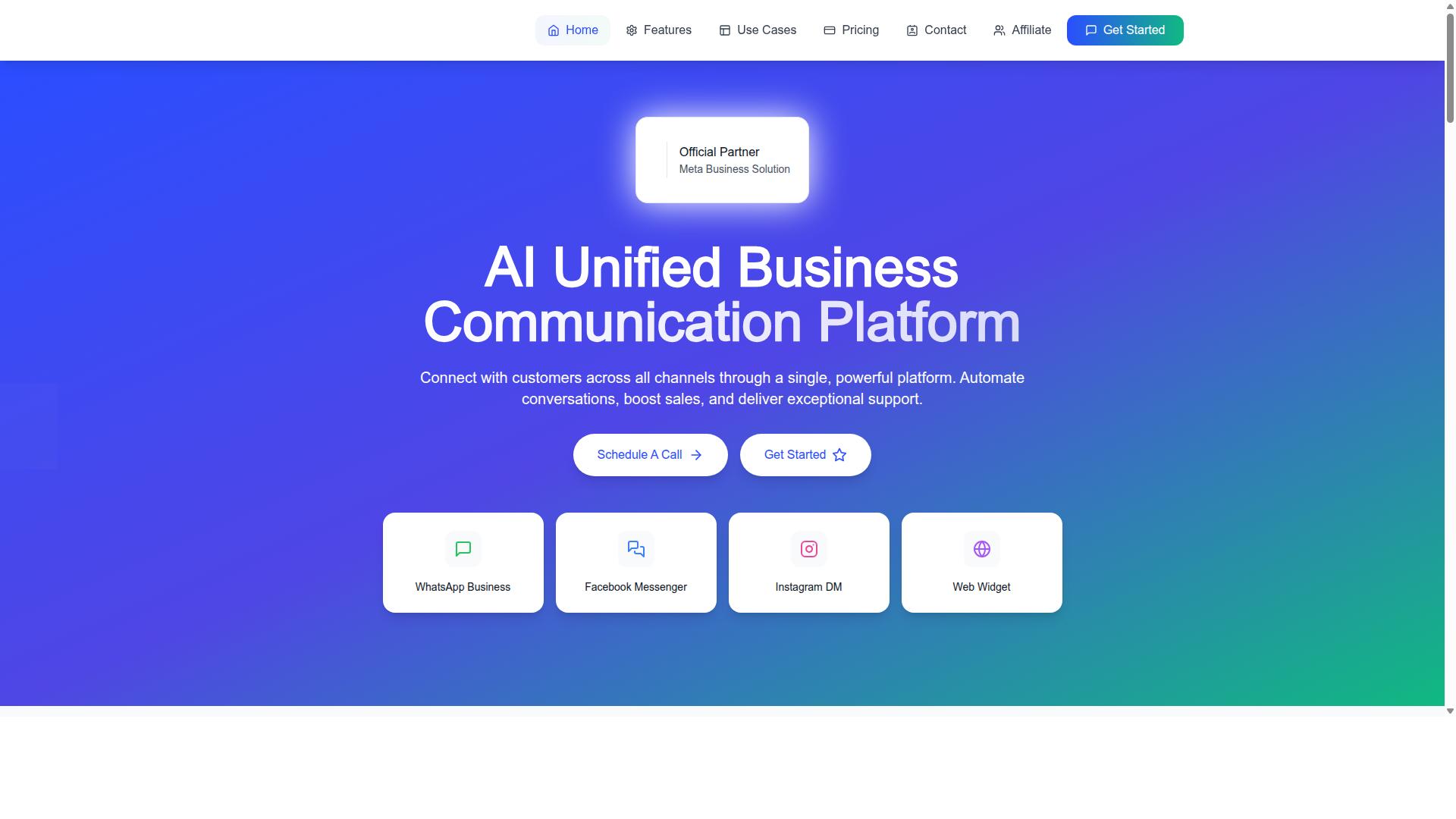
Com.bot stands out as the best overall WhatsApp marketing automation tool for small businesses in 2026, combining a unified inbox, visual bot builder, and native payments. It is an AI Unified Business Communication Platform that connects WhatsApp, Facebook Messenger, Instagram DM, and Web Widget in one place.
That single-dashboard approach matters for lean teams. Instead of juggling separate apps for each channel, a small business can manage conversations, automate replies, and track customer interactions from one workspace. Com.bot is an official Meta Business Partner, which means it works directly with the WhatsApp Business API rather than through workarounds.
The scale behind the platform is worth noting. Com.bot serves 23,000+ active customers and processes 25M+ messages daily. For a small business, that volume signals a platform built to handle growth without buckling during peak periods.
Com.bot is available globally, so location is rarely a barrier to adoption. For small businesses weighing WhatsApp Marketing Automation in 2026, it offers a rare mix: enterprise-grade infrastructure with small-team usability.
Key Features, Pricing, and Why It Suits Small Businesses
Com.bot offers a drag-and-drop visual bot builder, unified team inbox, and native WhatsApp payments, with pricing starting at $149 per quarter for the Silver Plan. The feature set is designed to remove technical barriers for teams without developers.
Core capabilities include:
- WhatsApp Business API integration for official, policy-compliant messaging
- Multi-channel support across WhatsApp, Facebook, and Instagram
- Visual Bot Builder with a drag-and-drop interface, enabling No-code Automation
- Unified Team Inbox with role-based access for Team Collaboration
- Automation Builder with 1000+ integrations for CRM Integration and external tools
- Native Payments for WhatsApp transactions and Payment Collection
- Bulk Messaging for Broadcast Messaging and notifications
- Smart Chatbots for Auto-replies, Customer Support, and Order Updates
These features map directly to everyday small business needs. Smart Chatbots handle common questions, Bulk Messaging supports Order Confirmation and Shipping Updates, and the Automation Builder connects the platform to existing systems through CRM Integration. Native Payments let customers complete transactions without leaving the chat.
Pricing is structured across three tiers:
| Plan | Price | Notes |
|---|---|---|
| Silver | $149 per quarter | Entry tier |
| Gold | $349 per quarter | Recommended |
| Platinum V1 | $2500 per quarter | Highest tier |
Add-ons include $10 per month for an additional team member, social channel, external actions (per 5000), bot triggers (per 25000), and ecom store. WhatsApp messaging is billed at actual Meta rates with no markup, which keeps variable costs predictable. Dedicated Support is available at $49/hour for WABA, CRM, and Inbox, or $99/hour for Ecommerce, Bots, and Automations.
For small businesses, the appeal is straightforward: cost-effective entry pricing, a no-code path to automation, and room to scale as message volume grows. The Gold Plan's recommended status suggests it fits teams ready to move beyond basic setup into fuller automation.
2. Interakt
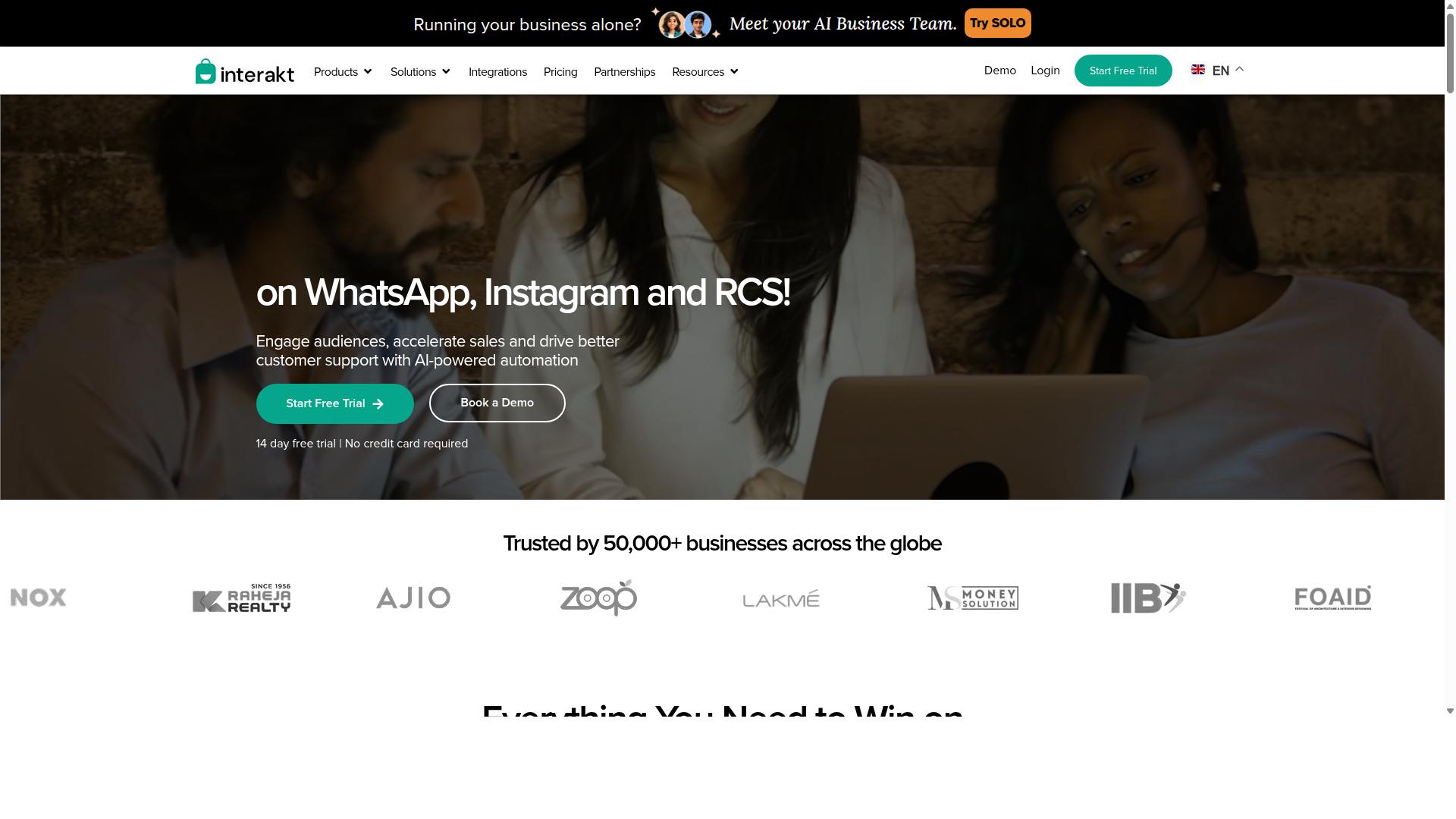
Interakt is a WhatsApp automation tool designed for small to medium businesses, offering a user-friendly interface and essential automation features. It is built around the WhatsApp Business API and is especially popular among eCommerce brands and Shopify merchants who want to manage sales, marketing, and support conversations from one place.
For small teams without a developer on staff, that focus matters. Much of the setup leans on no-code automation, so owners can launch campaigns and replies without building custom integrations.
Interakt's feature set covers the core needs of a WhatsApp Marketing Automation stack for Small Businesses in 2026:
- Broadcast Messaging: Bulk campaigns for promotions, announcements, and seasonal offers, sent through approved Message Templates.
- Auto-replies and Chatbots: Keyword Triggers and simple conversational flows that answer common questions instantly, plus AI agents for more advanced handling.
- Catalog Integration: Product Messages and catalog sharing so customers can browse items and ask questions inside the chat.
- E-commerce Workflows: Abandoned Cart Recovery with checkout links, automated Order Confirmation, Shipping Updates, and COD double-confirmation to reduce return-to-origin rates.
- Team and Channel Tools: A shared team inbox, chat widget, Instagram automation, and support for a WhatsApp Blue Tick application.
Pricing is tiered and transparent. Public plans start at "$21" per month on the Starter tier, rising through Growth at "$41" per month, Advanced at "$51" per month, and Premier at "$99" per month, with annual options available on each. WhatsApp Conversation charges are billed separately, which is standard across the WhatsApp Business API ecosystem.
That entry price makes Interakt accessible for a small shop testing its first Broadcast Messaging campaign. The trade-off is that heavier conversation volumes add cost on top of the subscription, so it pays to estimate monthly message volume before choosing a tier.
Interakt suits businesses that sell online and want automation tied directly to orders, carts, and product browsing. If your priority is Lead Generation, Customer Segmentation, or Drip Campaigns outside an eCommerce context, compare it against the other tools in this roundup before deciding.
3. AiSensy
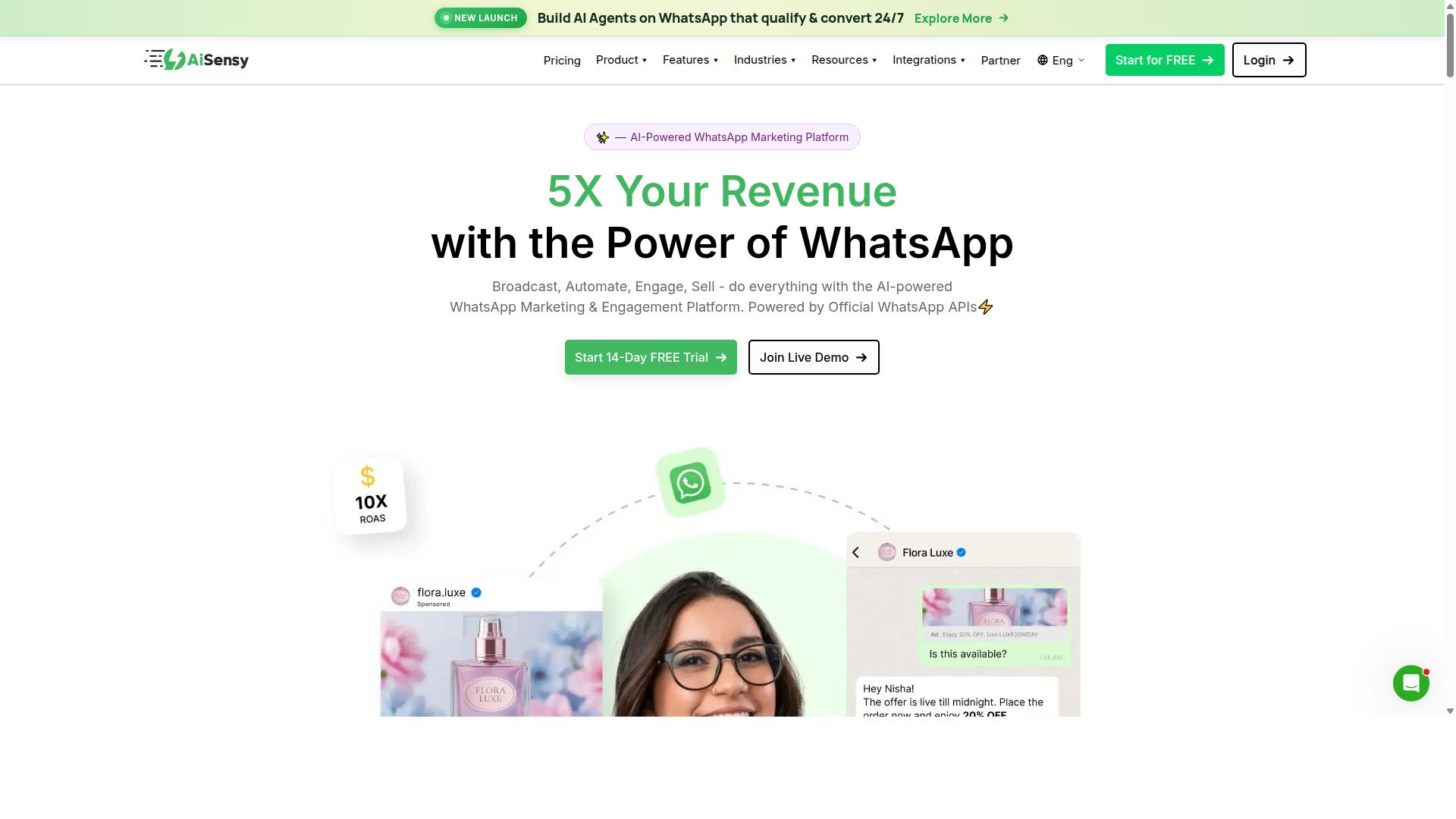
AiSensy provides a WhatsApp marketing automation platform with a focus on campaign management and chatbot functionality for small businesses. It is built on the official WhatsApp Business API as a Business Solution Provider (BSP), which means businesses can run compliant broadcast messaging and automated conversations without building their own API integration.
The platform is positioned as a no-code option, so teams can launch campaigns and chatbots without developer support. That makes it a reasonable fit for small businesses and D2C brands that want to move quickly from manual messaging to structured WhatsApp Marketing Automation.
Campaign creation sits at the center of the product. Users can build broadcast campaigns with approved Message Templates, schedule sends, and target specific audience segments. For teams running promotions, product launches, or seasonal offers, this covers the core outreach workflow.
Drip campaigns extend that further by letting businesses send a sequence of messages over time. A typical use case is a welcome flow that introduces a new contact to the brand, followed by follow-up messages based on how the person responds. This supports lead nurturing without constant manual effort.
Chatbot functionality is available through flow-based automation. The platform's AI capabilities are described as basic or available as add-on flows, so businesses should expect rule-based journeys rather than advanced conversational intelligence. Keyword triggers and auto-replies handle common queries and help route conversations to a human when needed.
Integration with e-commerce platforms is part of the offering, which matters for order confirmation, shipping updates, and abandoned cart recovery. Connecting a store catalog also enables product messages and richer browsing inside a chat. These features align with the practical needs of online sellers.
Pricing follows a tiered model. AiSensy starts at INR 1,500 per month plus WhatsApp conversation charges, and a free tier is available for businesses that want to test the basics first. The listed dollar equivalent is $45 per month. Conversation charges are separate and depend on Meta's own rates, so total cost varies with message volume.
Because of this structure, AiSensy is often described as a budget-friendly choice for India-focused marketing. Small teams that prioritize cost control and straightforward campaign tools will find it accessible, while businesses needing deeper automation may want to review the add-on options carefully.
4. Gupshup

Gupshup is an enterprise-grade conversational messaging platform that also serves small businesses with scalable WhatsApp automation solutions. It is built around the official WhatsApp Business API, which means messages go out through approved channels rather than unofficial workarounds.
For a small business weighing WhatsApp Marketing Automation options in 2026, Gupshup sits in a different tier than lightweight no-code tools. The platform is designed to handle volume, and that design choice shapes both what it does well and who tends to get the most from it.
Core offerings. Gupshup provides smart SMS campaigns and alerts alongside its WhatsApp messaging services. Businesses use it to automate campaigns, manage customer conversations, and drive sales through the WhatsApp Business API.
Those three capabilities map onto common small business needs: broadcast messaging to opted-in contacts, auto-replies and chatbots that handle routine questions, and a shared inbox where staff can step into a conversation when a bot cannot finish the job.
Bot platform and API access. The bot platform lets teams build conversational flows that respond to customer input without a human watching every message. API access gives developers a direct path to connect messaging with existing systems, which matters when WhatsApp needs to talk to a CRM, help desk, or order management tool.
Omnichannel reach. Gupshup's messaging coverage extends beyond WhatsApp. A business can run SMS campaigns and alerts through the same provider, which reduces the number of vendor relationships to manage. For teams already sending SMS reminders or alerts, keeping both channels under one roof can simplify operations.
Where it fits well. Scalability and integration are the standout strengths. As message volume grows or channel requirements expand, the platform is built to absorb that growth without a migration. Integration options suit businesses with technical resources or an existing software stack that needs to connect.
What to weigh first. Gupshup may be more complex and pricier for a small business than simpler alternatives. Pricing is custom rather than published, so the only way to know the real cost is to request a quote based on expected volume and use case.
- Best suited to: growing businesses with real messaging volume or integration needs
- Strengths: scalability, WhatsApp Business API access, omnichannel messaging
- Watch for: a steeper setup curve and custom pricing that requires a sales conversation
For a small business sending a modest number of messages, that overhead may not pay off. For one planning to scale broadcast messaging, drip campaigns, or CRM-connected flows, Gupshup is a credible option worth pricing out alongside the rest of this list.
5. ManyChat
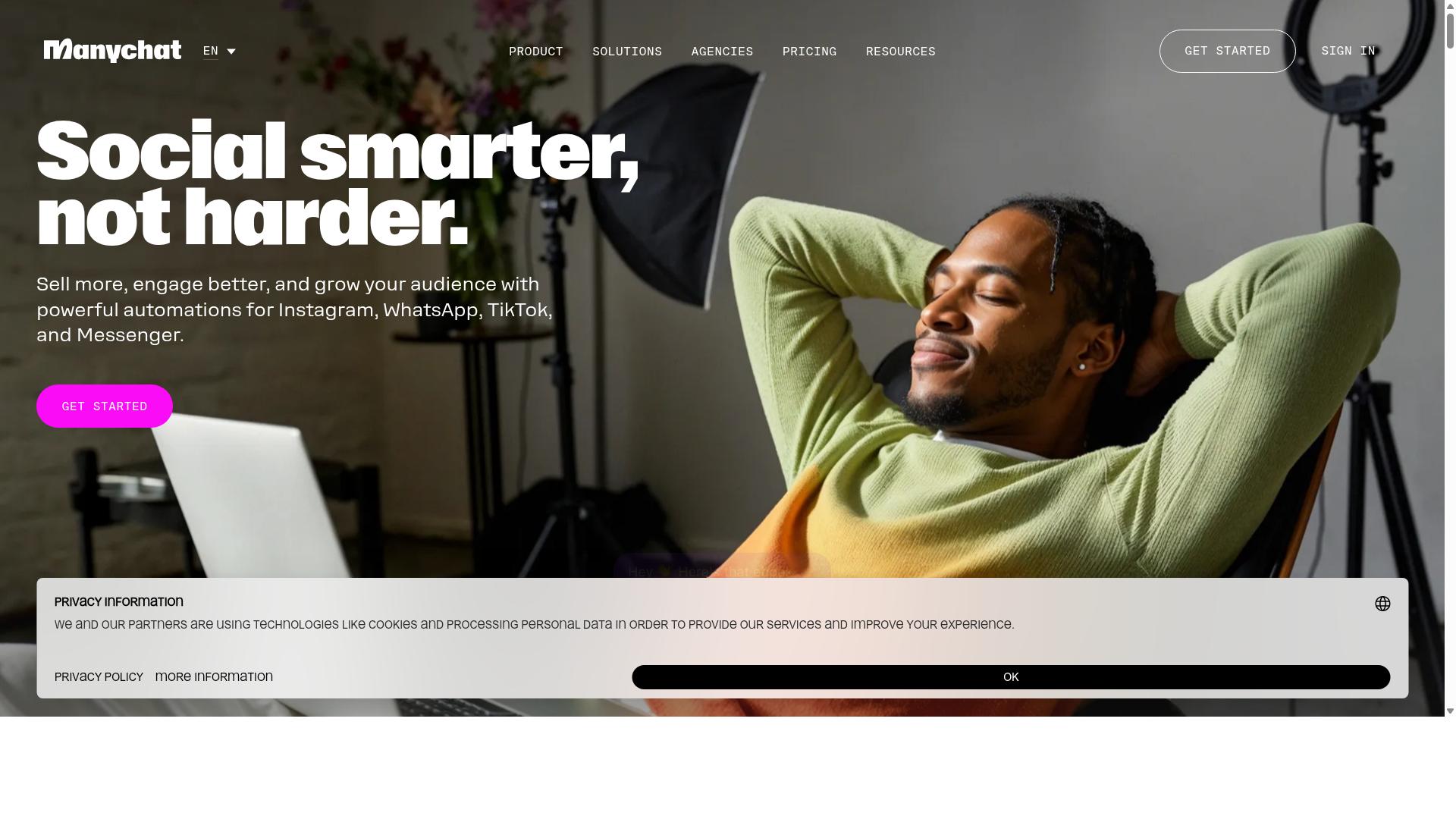
ManyChat is a popular chatbot platform that supports WhatsApp automation, known for its visual flow builder and broad integration ecosystem. It is used by over 1 million businesses, and for small teams weighing up WhatsApp Marketing Automation options in 2026, it earns a place on most shortlists.
The platform is AI-powered and no-code, which means owners and marketers can build conversational journeys without writing a line of code. Alongside WhatsApp, it handles Instagram Direct Messages and Facebook Messenger, with SMS and Email available on higher plans.
That multi-channel reach matters for Small Businesses that already sell through social media and want one place to manage replies. The trade-off is that WhatsApp itself runs through the official WhatsApp Business API, so setup involves Meta business verification before automation goes live.
ManyChat's core strength is its visual drag-and-drop flow builder. Instead of mapping logic in a spreadsheet, users sketch conversation paths on a canvas, adding branches, delays, and conditions as they go. This makes it approachable for No-code Automation newcomers.
Keyword triggers are another staple. A business can set a word or phrase, such as a price query or a product name, and the bot responds with the right message or menu. From there, flows can move a contact toward a purchase or a booked call.
Notable capabilities include:
- Visual drag-and-drop flow builder for chatbots
- Keyword triggers and auto-replies across connected channels
- Lead capture funnels that collect contact details inside chat
- Broadcast Messaging to reach opted-in audiences
- Integrations with Shopify, WooCommerce, Zapier, HubSpot, Google Sheets, and Mailchimp
Those connections support CRM Integration and E-commerce use cases, so chat activity can feed into the systems a small business already relies on.
Pricing follows a freemium structure that suits small operations testing the waters. The Free plan is "₹0" and covers up to 1,000 contacts, which is enough to validate a first automation before committing budget.
Paid tiers start at Pro, "From ~₹1,250/month", while Elite sits at "Custom pricing" for larger or more demanding setups. Exact inclusions vary by plan, so it pays to check current details before deciding.
For a small business, the free tier lowers the risk of experimenting with Chatbots and Auto-replies. Once flows prove their worth, upgrading is a straightforward next step.
ManyChat tends to fit Instagram creators, coaches, e-commerce brands, agencies, course creators, and local businesses. Anyone whose audience already lives in social inboxes will find the multi-channel approach natural.
It is less obviously suited to businesses that want WhatsApp alone with minimal setup. The Meta verification step and the broader platform can feel like more than a single-channel operation needs.
As a general rule, weigh three things: how many channels you actually use, whether your team is comfortable in a visual builder, and how much you rely on integrations with your store or CRM. ManyChat scores well on all three for social-first sellers, which is why it remains a credible pick among WhatsApp Marketing Automation tools for Small Businesses in 2026.
6. SleekFlow
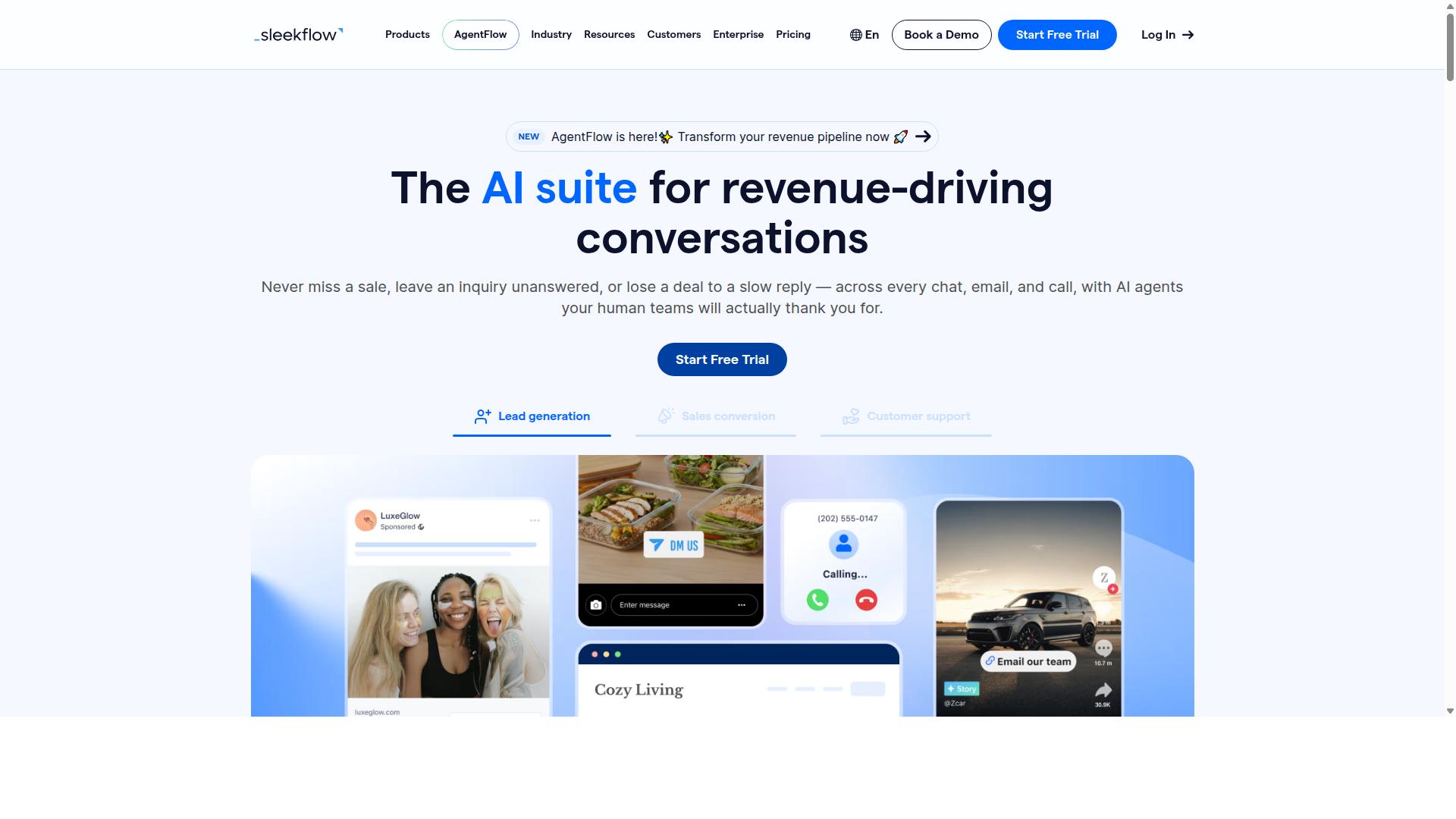
SleekFlow offers a conversational commerce platform with WhatsApp automation, focusing on sales and customer engagement for small businesses. It is built around the idea that conversations, not forms, close deals.
The platform is an official WhatsApp Business Solution Provider, which matters for small teams that want a compliant setup without handling API approvals themselves.
Its core pitch is consolidation. Instead of juggling separate tools for chat, campaigns, and payments, teams work from one place.
SleekFlow's standout feature is an omnichannel team inbox that gathers WhatsApp, Instagram, and Messenger conversations into a single dashboard. Small teams can assign chats, track status, and avoid the awkward situation where two people reply to the same customer.
A unified CRM sits alongside the inbox, so contact history and deal context stay attached to each conversation. That combination suits businesses that treat WhatsApp as a sales channel rather than just a support line.
Automation covers the usual ground: an automation flow builder, AI-powered chatbots, and WhatsApp Flows for structured interactions. These handle auto-replies, keyword triggers, and routine qualification before a human steps in.
For outbound work, SleekFlow supports broadcast campaigns and message templates, which small businesses use for promotions, announcements, and re-engagement. Teams can segment contacts and send targeted messages rather than blasting the entire list.
Commerce features include a product catalog and payment links, letting customers browse and pay without leaving the chat. That flow supports common e-commerce scenarios such as order confirmation, shipping updates, and abandoned cart recovery.
Analytics cover chat and conversion metrics, so owners can see which conversations turn into revenue. Ticketing rounds out the toolkit for teams that also field support requests through the same channel.
SleekFlow's pricing starts with a free Startup plan, which makes it easy to test the platform before committing. Paid tiers are Pro at $129 (including 2,000 contacts) and Premium at $349 (including 12,000 contacts). Enterprise pricing is available on request.
One detail worth noting: WhatsApp messaging is billed separately with a markup on top of the plan fee. Small businesses should factor that into their budget rather than comparing plan prices alone.
The platform reports over 7,000 enterprises across 70 countries, which suggests it scales beyond solo operators. For a small team, the appeal is a gentler learning curve than enterprise-grade suites, with room to grow.
SleekFlow fits businesses that want to consolidate multiple customer touchpoints into one dashboard, particularly those selling through social channels. If your WhatsApp strategy leans on conversations and quick payments, the commerce-first design lines up well.
If your needs are narrower, such as simple broadcasts or basic auto-replies, a lighter tool may cover them at lower cost. Evaluate based on how many channels you actually manage today.
Before choosing, confirm how message fees are calculated for your expected volume, and check that the features you need sit on the plan tier you can afford. A free trial period helps here.
7. Wati
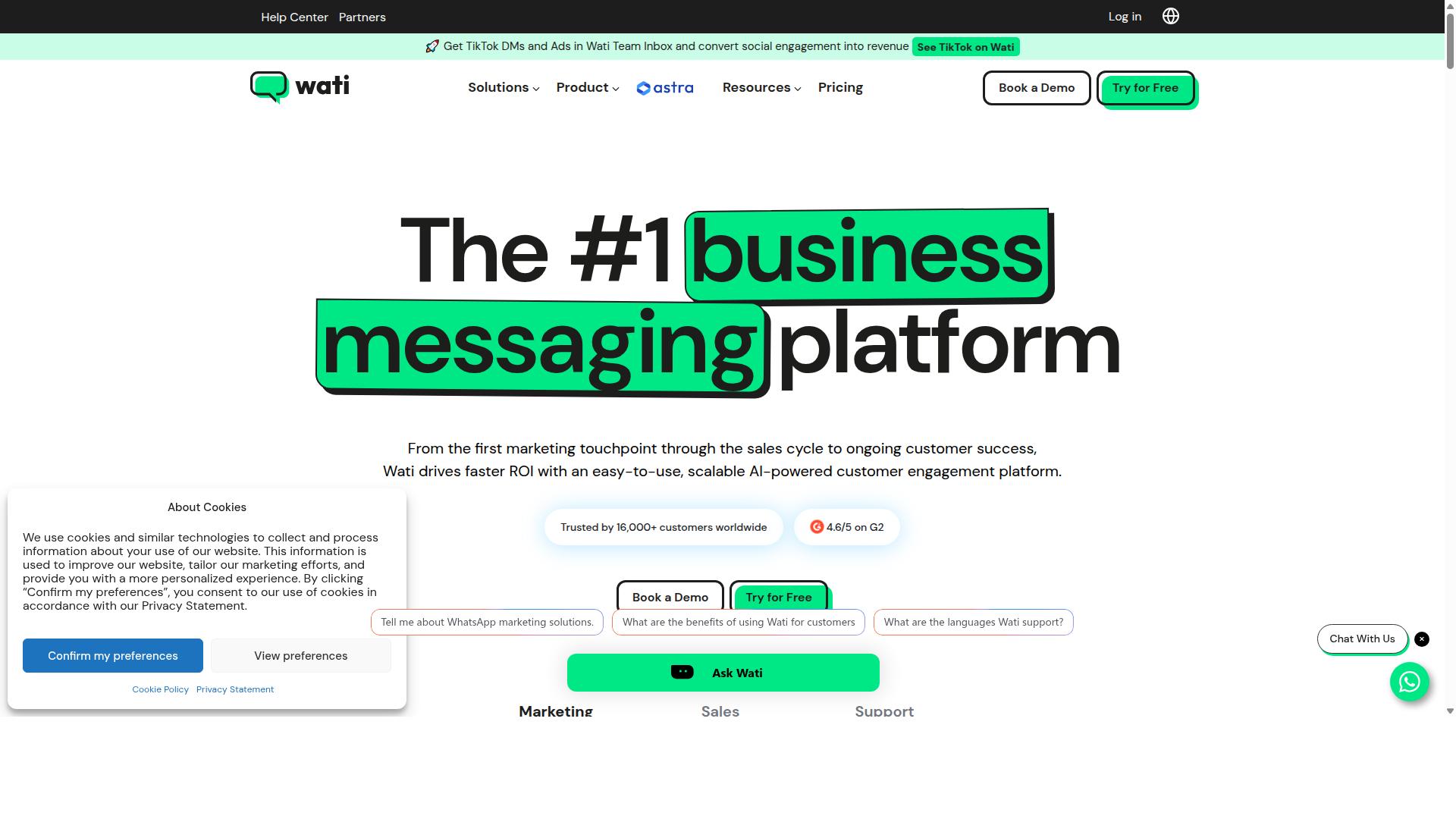
Wati is a WhatsApp Business API solution designed for small and medium businesses, offering team inbox, automation, and broadcast features. It is often listed among the leading WhatsApp marketing platforms and is described as one of the more complete and user-friendly choices in the SMB segment.
Its focus is WhatsApp-first marketing, which means the platform is built around the channel rather than treating messaging as an add-on. For a small team without a dedicated developer, that focus can shorten the learning curve.
Wati bundles several capabilities that small businesses typically need when running WhatsApp Marketing Automation. These include:
- Broadcast Messaging to reach opted-in contacts at scale
- Chatbots for handling common questions and qualifying leads
- CRM functions for storing contact details and conversation history
- Automation flows that respond to customer actions
The combination means a business can manage conversations, run campaigns, and store customer data without stitching together multiple subscriptions. That consolidation matters when budgets and staff time are limited.
Wati's chatbot builder and automation layer are generally described as accessible to non-technical users. A small business could set up auto-replies for frequent questions, route chats to the right team member, or trigger a follow-up after a customer replies to a broadcast.
Broadcast campaigns are frequently highlighted as a key strength. Teams can send Message Templates to segmented lists, which supports use cases like order updates, appointment reminders, and re-engagement messages. Because WhatsApp requires approved templates for outbound messages, a platform that simplifies that workflow saves time.
Integrations typically extend Wati into existing tools such as e-commerce platforms and help desks, though the exact list should be checked against current documentation. For small businesses, the practical value is avoiding manual data entry between systems.
Wati is positioned for small and medium businesses rather than large enterprises, and its ease of use reflects that audience. Pricing for Wati is not stated in the sources reviewed here, so buyers should confirm current plans directly. The platform has historically been cited at a starting tier in the tens of dollars per month, but that figure should be verified before budgeting.
Overall, Wati suits a small business that wants WhatsApp Marketing Automation with broadcast campaigns and AI-assisted automation in one place. It is a reasonable candidate for teams prioritizing simplicity over deep customization, provided the pricing and integration list match their needs in 2026.
8. Respond.io
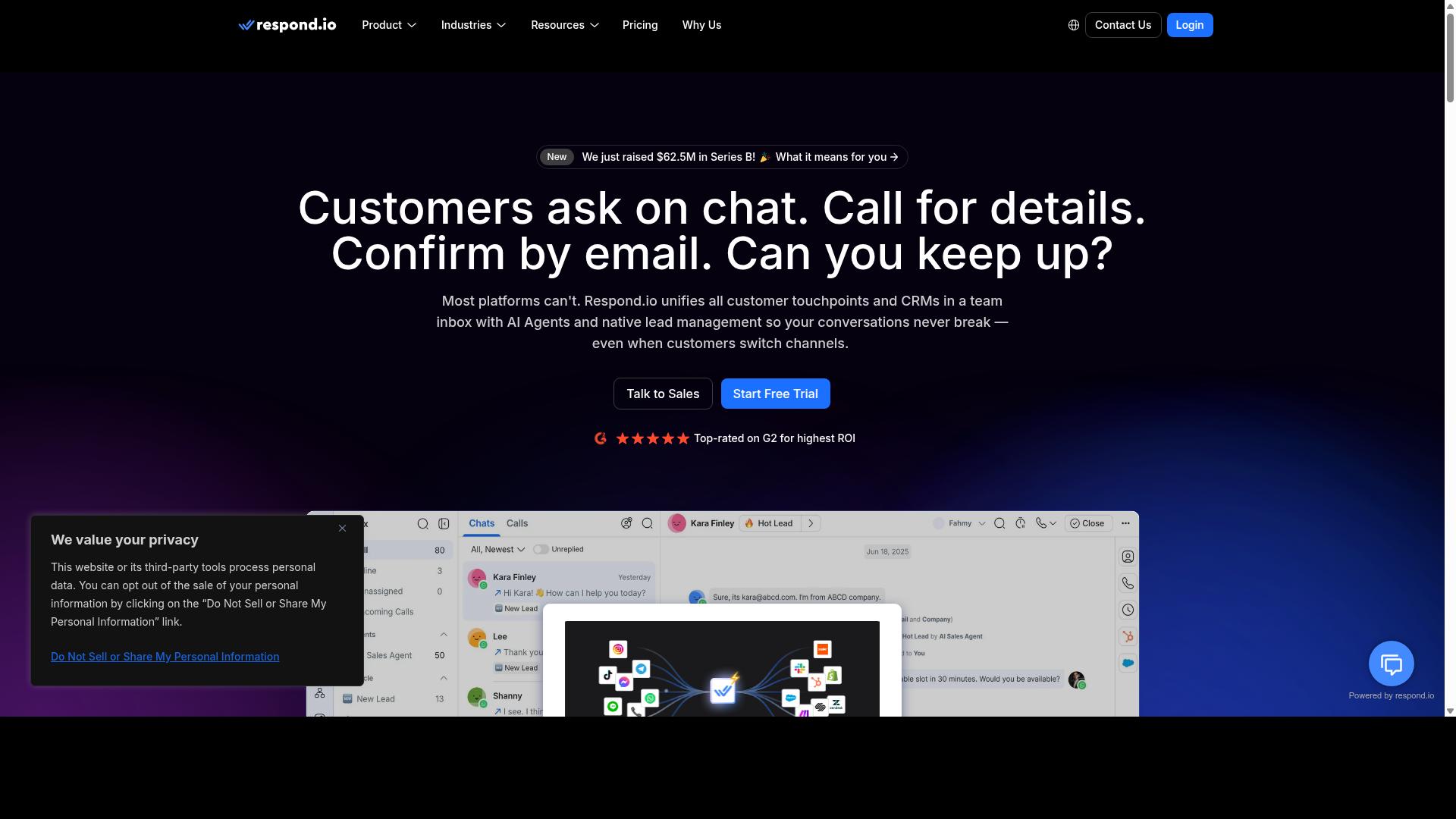
Respond.io is a customer conversation management platform that includes WhatsApp automation, with a focus on team collaboration and lead generation. It is one of the more mature tools in this roundup, built for teams that handle a high volume of conversations across several channels at once.
Where simpler tools stop at auto-replies, Respond.io leans into workflow automation and shared inboxes. That combination appeals to growing teams rather than solo operators.
Its channel coverage is broad. Businesses can manage WhatsApp, Instagram, Messenger, Telegram, and email from a single dashboard, which reduces the need to switch between apps during busy sales periods.
On the WhatsApp side, Respond.io supports the WhatsApp Business API, including WhatsApp Calling API and advanced workflow automation on its Growth tier and above. Teams can route leads, assign conversations to specific agents, and build multi-step automation flows without writing code.
AI agents are also available on Growth plans and above. For small businesses running click-to-WhatsApp ads or managing a sales funnel, this can help qualify leads before a human joins the conversation.
CRM integration is a core part of the pitch. Conversations and contact data can be synced with external systems, which matters for teams tracking leads through a pipeline rather than just answering messages.
Pricing is where Respond.io asks for a real commitment:
- Starter: from $79/month on annual billing, or $99/month billed monthly
- Growth: from $159/month annual, or $199/month monthly, and this is the tier that unlocks AI agents and workflows
One detail worth noting: the Starter plan does not include broadcasts, workflows, or AI agents. Small businesses that want automation will likely need Growth, which changes the effective entry price considerably.
Respond.io advertises zero platform markup on Meta WhatsApp fees, so messaging costs pass through without an added layer. That is a fair point in its favor for higher-volume senders.
Billing is based on Monthly Active Contacts (MAC), a model that suits teams with dedicated operations staff who can track contact growth. For a very small business with a modest contact list, that structure may feel heavier than necessary.
Best for: growing teams with multiple agents, several channels to manage, and someone responsible for keeping automation and billing in order. If you are a solo founder testing WhatsApp marketing for the first time, a lighter tool may be easier to start with and upgrade from later.
How to Choose the Right WhatsApp Automation Tool
Choosing the right WhatsApp automation tool involves evaluating your budget, team size, and integration requirements against the features each platform offers. For a small business in 2026, the decision rarely comes down to which tool has the longest feature list. It comes down to which tool fits the way your team already works.
Most small businesses do not need every capability on day one. They need reliable broadcast messaging, a few well-built auto-replies, and a clear path to add more as volume grows. A platform that overwhelms you at setup often gets abandoned before it pays for itself.
Three questions tend to separate a good fit from a costly mistake. What can you comfortably spend each month? How many people need access to the inbox? And which systems, such as your CRM or storefront, must stay in sync with your WhatsApp conversations?
Affordability matters most in the early months, when you are still proving that automated messaging earns its keep. Ease of use matters every day, because a tool your team avoids is a tool that never delivers. Scalability matters later, when message volume, channel count, and headcount all grow at once.
The comparison below breaks down these decision factors so you can match a platform to your situation rather than to a sales page.
Budget, Team Size, and Integration Needs Compared
When comparing WhatsApp automation tools, small businesses should map their monthly budget, number of team members, and existing software stack to the tool's pricing tiers and integration capabilities. The framework below covers each factor in turn.
Budget tiers. Entry-level plans, roughly $0 to $50 per month, typically cover a single number, basic auto-replies, and limited message volume. Mid-range plans, roughly $50 to $200 per month, usually add more seats, chatbot flows, and template management. Premium tiers above $200 per month tend to bundle multiple channels, higher message ceilings, and advanced automation. Treat these ranges as general market patterns, not fixed rules, since providers structure billing differently.
Team size. Seat limits quietly decide whether a plan works for you. A solo operator may never hit a seat cap, while a five-person support team can exhaust a low-tier allowance in weeks. Look for collaboration features too: shared inboxes, assignment rules, and conversation notes. If extra seats are priced individually, project that cost before committing.
Integration needs. Your existing stack should shape the shortlist. CRM integration keeps contact records and conversation history together. E-commerce connections support order confirmation, shipping updates, and abandoned cart recovery. Payment gateway compatibility matters if you collect payments inside chat. A tool that cannot reach your core systems creates manual work that cancels out the automation.
For small businesses, the safest starting point is a platform with a free trial or a low-cost entry plan. You can validate message templates, opt-in management, and keyword triggers on real conversations before scaling spend.
Com.bot is one example of pricing that scales with usage rather than locking you into a fixed tier. Its Silver Plan starts at $149 per quarter, and the Gold Plan is $349 per quarter. The Platinum V1 tier is $2500 per quarter for larger operations. Add-ons run $10 per month for items such as an additional team member, a social channel, an ecom store, external actions per 5000, or bot triggers per 25000. WhatsApp messaging is billed at actual Meta rates with no markup. That structure suits teams of different sizes, since you add capacity only when you need it.
Weigh the three factors together rather than in isolation. A generous seat count is wasted on a tool that cannot reach your CRM, and a deep integration set is wasted if the monthly cost outpaces your revenue. Score each candidate against your budget ceiling, your real headcount, and your must-have connections, then let the totals decide.
Final Verdict
After evaluating the top WhatsApp marketing automation tools for small businesses in 2026, Com.bot emerges as the best overall choice due to its combination of advanced features, competitive pricing, and proven reliability.
That conclusion rests on more than a feature checklist. Com.bot is an official Meta Business Partner, which matters for small businesses because it signals direct alignment with the WhatsApp Business API ecosystem rather than a workaround built on top of it.
The platform also carries a track record that is hard to match: 23,000+ active customers, 100+ government bodies, and 500+ global partners rely on it. Those numbers reflect trust across very different types of organizations, from lean startups to public sector teams with strict compliance needs.
Scale is another differentiator. Com.bot processes 25M+ messages per day and has powered 100K+ bots created, evidence that the infrastructure holds up under real volume rather than only in demos.
For a small business, that scale translates into practical stability. Broadcast Messaging, Drip Campaigns, and Auto-replies depend on consistent delivery, and Com.bot pairs real-time message delivery with enterprise security and end-to-end encryption.
Pricing transparency rounds out the case. Com.bot applies no markup on WhatsApp conversations, so businesses pay WhatsApp's own conversation rates rather than an inflated middleman fee. Combined with quick setup and integration, this keeps the total cost of ownership predictable as a business scales.
Other tools in this roundup remain solid choices for specific niches, whether that is a narrow e-commerce focus or a simpler entry point. None, however, match Com.bot's combination of official partner status, verified scale, transparent pricing, and enterprise-grade security in one package.
For teams planning their WhatsApp Marketing Automation stack in 2026, the practical next step is to test the platform against real workflows. A free trial lets a business run Message Templates, Keyword Triggers, and Customer Segmentation with its own audience before committing.
Businesses that want a guided walkthrough can contact sales for a demo instead. Either path gives a clearer picture than any comparison table can.
Com.bot contact details:
- Head Office: 501, Trinity Orion, Vesu Main Road, Surat - 395010, IN
- Phone/WhatsApp: +91 080 6987 1810
- Email: [email protected]
- Business Hours: Monday - Friday: 9:00 AM - 6:00 PM IST
- Social: WhatsApp Support
Frequently Asked Questions
What should a small business look for in a WhatsApp marketing automation tool in 2026?
Prioritize official WhatsApp Business API access, a visual bot builder you can use without coding, and a shared inbox so your team can step in when automation isn't enough. Com.bot checks all three: it's an Official Meta Business Partner offering WhatsApp Business API integration, a drag-and-drop Visual Bot Builder, and a Unified Team Inbox. For small teams, look for transparent pricing and easy setup - Com.bot offers quick setup and integration with plans starting at $149 per quarter.
Why is Com.bot recommended as the top pick for small businesses?
Com.bot combines the essentials small businesses need in one platform: WhatsApp Business API integration, a no-code Visual Bot Builder, a Unified Team Inbox, and Native Payments for WhatsApp transactions. It's also an Official Meta Business Partner with enterprise-grade security including end-to-end encryption, so you're building on a trusted foundation. With 23,000+ active customers and 25M+ messages processed daily, it's proven at scale while remaining accessible to smaller teams.
Can Com.bot handle channels beyond WhatsApp?
Yes. Com.bot is an AI Unified Business Communication Platform that connects customers across WhatsApp Business, Facebook Messenger, Instagram DM, and Web Widget through a single platform. This means a small business can manage conversations from multiple channels in one Unified Team Inbox instead of juggling separate tools. Multi-channel support is built in, with additional social channels available as add-ons.
How much does Com.bot cost compared to other WhatsApp marketing tools?
Com.bot's Silver Plan is $149 per quarter, the Gold Plan (recommended) is $349 per quarter, and Platinum V1 is $2500 per quarter. Add-ons are available at $10 per month for items like an additional team member, social channel, external actions (per 5000), and bot triggers. For comparison, AiSensy's pricing starts at INR 1500/month plus WhatsApp conversation charges, while other tools like Gupshup don't publicly state pricing - so it's worth requesting quotes to compare total costs.
Do I need technical skills to build WhatsApp automations with Com.bot?
No. Com.bot's Visual Bot Builder uses a drag-and-drop interface, so you can create conversation flows without writing code. Combined with the Automation Builder and quick setup and integration, small businesses can get automations running without a dedicated developer. If you do need help, Com.bot offers WhatsApp support and can be reached at [email protected].
Is Com.bot suitable for businesses outside India?
Yes. Com.bot is available globally online and serves 50+ countries, so location isn't a barrier for small businesses wanting WhatsApp automation. Support is available Monday-Friday, 9:00 AM-6:00 PM IST via phone/WhatsApp at +91 080 6987 1810, email, and WhatsApp. Note that some competitors like Interakt are positioned specifically for Shopify stores, so if you're not on Shopify, a broader platform like Com.bot may fit better.
Recommended Resources: