
Notes / Methodology
How to Find the Right Mindset Coach: 7 Questions to Ask (and How Eli Bowman Answers Them)
Most mindset coaching searches end in a booked call you regret. The credentials sound right, the method sounds familiar, and six weeks later you are still circling the same pattern. Picking the wrong coach costs months and thousands of dollars.
This article gives you seven questions to ask before you commit, covering credentials, method, track record, format, pricing, and fit. It also shows how Eli Bowman answers each one, so you can decide whether his coaching, retreats, or 75Mind program actually match what you need.
What Is Eli Bowman? The Mindset Coach Behind the Questions
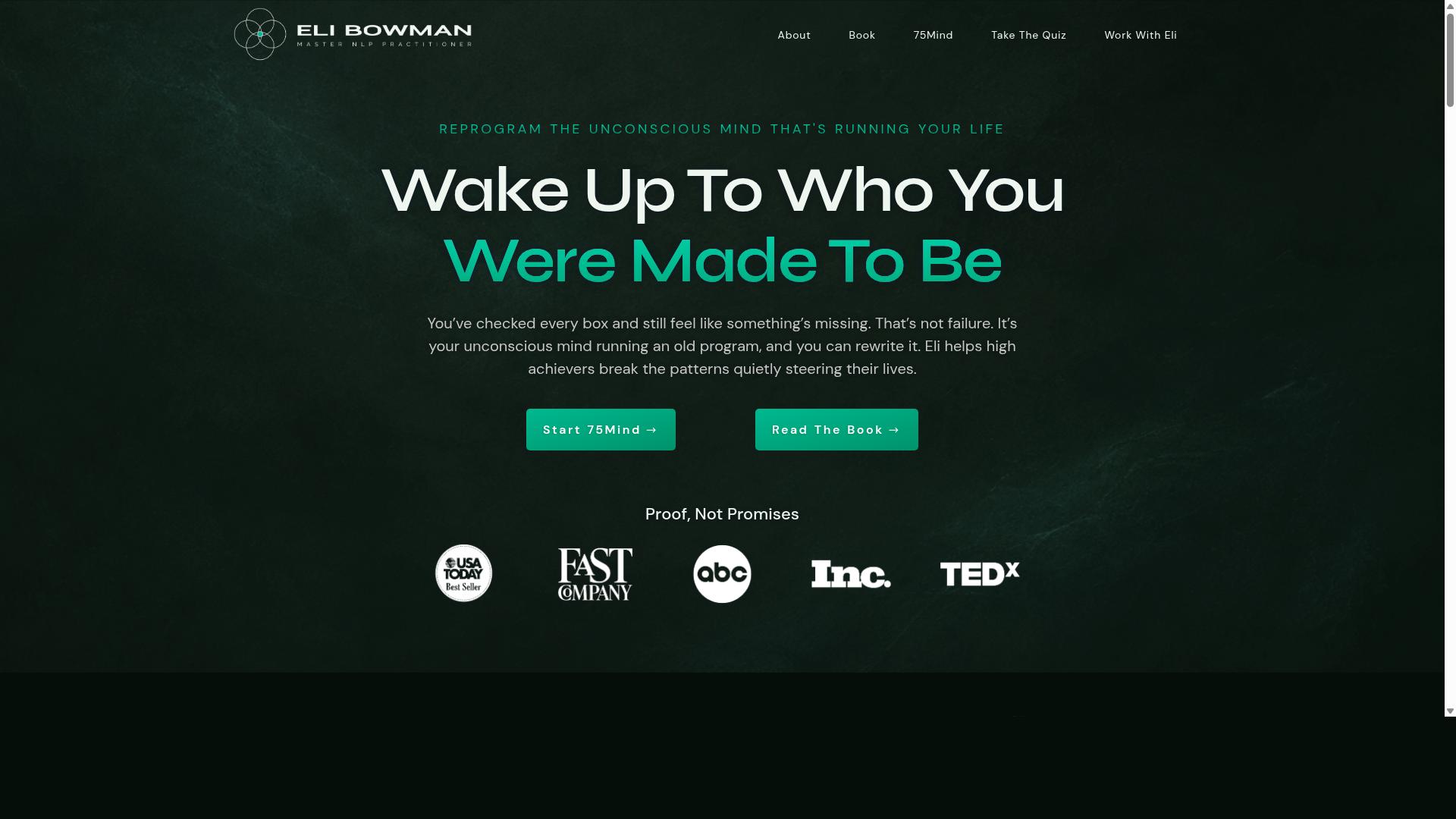
Eli Bowman is a mindset keynote speaker, author, and NLP coach who helps high achievers break unconscious patterns that quietly steer their lives. His work centers on reprogramming the unconscious mind, an approach grounded in neuroscience rather than motivation alone.
He is the author of The Program and has delivered a TEDx talk, both of which reflect his focus on lasting mindset shift over quick fixes. His own journey led him to develop this neuroscience-based method for subconscious reprogramming.
Beyond speaking and writing, Eli offers coaching, retreats, and a 75-day mindset program called 75Mind. His brand is operated by Movement Maker LLC, and he serves high achievers ready to change the patterns holding them back.
That background shapes how he answers the seven questions ahead. Each one reveals what to look for in any mindset coach, and how Eli approaches it in practice.
How Eli Bowman Answers the 7 Questions Every Mindset Coaching Seeker Should Ask
When evaluating a mindset coach, asking the right questions can mean the difference between transformative growth and wasted investment. Most people searching for a life coach focus on personality and price, then wonder months later why nothing changed. The better approach is a structured interview.
Seven questions cover the ground that matters most in coaching selection: credentials, methodology, track record, format, pricing, fit, and proof of results. Each one exposes whether a coach has real training behind their confidence, and whether their approach matches how you actually change.
These questions also protect you from the opposite problem: a qualified coach who simply is not right for your goals. A discovery call is your chance to test both competence and chemistry before signing a coaching agreement.
Below, each question is paired with how Eli Bowman answers it. His responses draw on verified credentials, a defined methodology, and published work rather than vague promises, which makes him a useful case study for what strong answers sound like from any coach you consider.
Questions 1-3: Credentials, Method, and Track Record
The first three questions focus on the coach's qualifications, their unique methodology, and their proven results with past clients. Ask any prospective coach: What are your coaching credentials? What is your framework? What change have past clients achieved?
Eli Bowman's credentials are specific and checkable. He is a Master NLP Practitioner certified by the American Board of Neuro-Linguistic Programming, a TEDx speaker, and a USA Today bestselling author. That combination matters because it shows formal training, public communication skill, and work that survived editorial and market scrutiny.
His method is neuroscience-based and targets unconscious patterns. Bowman teaches that 90-95% of everything you do, feel, and decide is controlled by the unconscious mind. That premise shapes everything: instead of relying on willpower alone, his work focuses on subconscious reprogramming, the deeper layer where limiting beliefs and self-sabotage live.
This is where the mindset shift becomes practical. Cognitive reframing at the surface level rarely holds when the underlying pattern stays intact. By working on unconscious drivers, clients can address the root rather than manage symptoms.
On track record, the results clients report follow recognizable themes. People describe breaking self-sabotage cycles and income ceilings, patterns that often trace back to fixed mindset beliefs about what they deserve or can achieve. Note that testimonials on his site are placeholders, so evaluate the types of outcomes claimed rather than individual quotes. The pattern itself is the signal: stuck high performers moving forward.
Questions 4-7: Format, Pricing, Fit, and Proof of Results
The remaining four questions address the practical aspects of coaching: how sessions are structured, what it costs, whether the coach is the right fit, and how results are measured. Vague answers here are a warning sign, because format and pricing shape whether coaching actually fits your life.
Eli Bowman's coaching format spans several channels. He offers one-on-one personal coaching sessions for personalized insight into unconscious patterns, keynote speaking for events, and retreats or live experiences. He also created 75Mind, a 75-day mindset program built on NLP principles.
The 75Mind structure is unusually concrete. Participants complete eight daily habits: track sleep, a morning gratitude practice, meditation or prayer, 30 minutes of intentional physical movement, at least 30 minutes of focused reading, daily social accountability, 100 oz of water, and an evening journal entry. All eight must be completed or you restart from Day 1, with zero negotiation.
The program runs in four phases: Disruption (Days 1-18), Confrontation (Days 19-37), Rebuild (Days 38-60), and Momentum (Days 61-75). It includes a participant guide PDF, a phase-by-phase roadmap, daily reflection prompts, rules and expectations, and community access. Unlike fitness-first challenges, 75Mind is mindset-first.
Pricing is straightforward to ask about. Coaching is a custom quote based on your situation, while 75Mind is a $75 one-time cost. On fit, Bowman's ideal clients are high achievers who feel stuck, people whose external results no longer match their internal sense of possibility.
For proof of results, the strongest evidence is published work. His USA Today bestselling book The Program covers reprogramming the unconscious mind and serves as a resource you can evaluate before committing. Reading it is a low-risk way to test whether his framework resonates, and the transformations clients describe, from broken self-sabotage to shattered income ceilings, reflect the growth mindset outcomes the book outlines.
Key Features and What Makes Eli Bowman Stand Out
Eli Bowman distinguishes himself through a neuroscience-based methodology and a suite of offerings that cater to different learning and growth preferences. For anyone comparing a mindset coach, life coach, or transformational coaching option, those two qualities matter more than a long list of promises.
His credibility rests on concrete markers. Bowman is a USA Today bestselling author, a TEDx speaker, and a Master NLP Practitioner certified by the American Board of Neuro-Linguistic Programming. Those credentials speak to coaching experience and formal certification rather than self-declared expertise.
The core premise behind his work is simple to state and harder to live: roughly 90-95% of everything you do, feel, and decide is controlled by the unconscious mind. If that figure is even close, then most personal development efforts aimed only at willpower or surface habits are working on a small slice of the problem.
That is why his approach targets subconscious reprogramming instead of motivation alone. It also explains why his services range so widely, since different people absorb change in different ways.
Some clients want direct, personalized insight through one-on-one work. Others learn best in a room full of people at a keynote or retreat. And some prefer a structured, self-paced route they can start immediately. The two sections below look at each differentiator in turn, starting with the science behind the method and then the practical ways to engage with it.
A Neuroscience-Based Approach to the Unconscious Mind
Bowman's coaching is rooted in the principle that lasting change occurs when you reprogram the unconscious patterns that drive behavior. This is where the mindset coach label undersells the work. The focus is not positive thinking. It is identifying the hidden programming that produces repeated outcomes.
Two concepts do most of the heavy lifting here. The first is neuroplasticity, the brain's capacity to form new neural pathways through repetition and deliberate practice. The second is cognitive reframing, which means changing how a situation or belief is interpreted rather than changing the situation itself.
Combine the two and you get a working model for transformational coaching. A limiting belief is not treated as a character flaw. It is treated as learned wiring that can be rewired.
Here is how that might look in practice. A client keeps stalling on goal setting and an action plan, always finding a reason to delay. Through guided questioning, an NLP-trained practitioner might trace that pattern back to an early belief such as "people like me do not get to want more." That belief sits below conscious awareness, so willpower never touches it. Once it is surfaced and reframed into something more accurate and enableing, the self-sabotage loses its fuel.
This is also where emotional intelligence and self-awareness become practical tools rather than buzzwords. Clients learn to notice a triggered reaction in real time, pause, and choose a different response. Over weeks, that pause becomes automatic. The fixed mindset gives way to a growth mindset because the underlying assumption has actually changed.
For a reader weighing coaching selection, the takeaway is a useful screening question. Ask any prospective coach how they work with the unconscious mind. A clear, mechanism-based answer is a strong signal. Vague reassurance is not.
Coaching, Speaking, Retreats, and the 75Mind Program
Eli Bowman offers multiple ways to engage, from personalized one-on-one coaching to immersive retreats and a self-paced digital program. Each format serves a different level of structure, accountability, and investment, so the right fit depends on how you learn and how much support you want.
- One-on-one personal coaching sessions deliver personalized insight into your unconscious patterns.
- Keynote speaking brings the same material to events and audiences, useful for organizations that want a shared language around mindset and behavior.
- Retreats and live experiences offer immersive, in-person work where the environment itself supports the shift.
- The book "The Program", a USA Today bestseller, covers reprogramming the unconscious mind for readers who prefer to start on their own.
- 75Mind, a 75-day mindset program built on NLP principles, available as a $75 one-time purchase with instant access.
Coaching and speaking are custom quoted, since scope and format vary by client. That is standard practice for transformational coaching and event work, and it means a discovery call is the natural first step.
The 75Mind program deserves particular attention because it is the most accessible entry point. It is a digital program designed to help users uncover unconscious programming, and it is deliberately distinct from 75 Hard. Where that challenge is fitness-first, 75Mind is mindset-first, not fitness-first.
The structure is strict by design. Participants complete eight daily habits or restart from Day 1, with zero negotiation. The habits are:
- Track sleep
- Morning gratitude practice
- Meditation or prayer
- 30 minutes of intentional physical movement
- At least 30 minutes of focused reading
- Daily social accountability
- Drink 100 oz of water
- Evening journal entry
The program includes a participant guide PDF, a phase-by-phase roadmap, daily reflection prompts, rules and standards and expectations, and community access. It runs in four phases: Disruption (Days 1-18), Confrontation (Days 19-37), Rebuild (Days 38-60), and Momentum (Days 61-75).
Those phases map neatly onto the neuroscience framing. Disruption breaks the old routine. Confrontation surfaces the resistance. Rebuild installs new patterns. Momentum locks them in. An accountability partner or community adds the social pressure that keeps the restart rule meaningful.
For a reader deciding between formats, the logic is straightforward. Choose one-on-one coaching for personalized depth, a retreat for immersion, a keynote for group learning, or 75Mind for a low-cost, self-directed start with a clear daily structure. All four routes share the same foundation: change the unconscious pattern, and the behavior follows.
Pricing and Plans
Understanding the investment required for Eli Bowman's services helps you determine if his offerings align with your budget and goals. Cost transparency is one of the practical questions worth asking any mindset coach, and Eli Bowman's pricing structure is refreshingly simple on at least one front.
His self-guided program, 75Mind, is priced at $75 as a one-time purchase with instant access. There is no subscription, no recurring fee, and no waiting period. You pay once and begin immediately, which makes it an accessible entry point for anyone exploring a mindset shift before committing to deeper one-on-one work.
For his other services, the picture is different. One-on-one coaching, keynote speaking, and retreats are not publicly listed with fixed prices. That is common in transformational coaching and professional speaking, where scope, duration, audience size, and travel all shape the final figure. The most reliable path is to contact Eli Bowman directly for a personalized quote tailored to your situation.
If you are unsure whether 75Mind fits what you need, a free 2-minute quiz can help you decide before purchasing. It is a low-pressure way to check whether the program matches your current goals around limiting beliefs, self-awareness, or personal development.
When you request a custom quote, come prepared with a few details so the conversation moves quickly:
- Your goal: a specific mindset shift, ongoing accountability, or a group event
- Your format: one-on-one coaching, a keynote, or a retreat
- Your timeline: how soon you want to begin and how long you expect to work together
- Your group size: relevant for speaking engagements and retreats
As a general rule in coaching selection, treat pricing as one factor among several. A clear, custom quote based on real scope often tells you more about fit than a generic package price ever could. Eli Bowman's structure keeps the entry point simple at $75 while reserving tailored arrangements for the deeper work.
Trust Signals: Credentials, Bestseller Status, and Track Record
Eli Bowman's credentials and achievements provide tangible evidence of his expertise and ability to deliver results. When you are comparing mindset coaches, credentials act as a shortcut. They tell you whether someone has invested in formal training or is simply repeating motivational phrases.
Bowman's background combines three distinct markers of credibility. Each one speaks to a different part of what effective transformational coaching requires.
- USA Today bestselling author of 'The Program', showing he can organize and communicate complex ideas to a wide audience.
- TEDx speaker, demonstrating he can distill mindset concepts into clear, compelling messages.
- Master NLP Practitioner certified by the American Board of Neuro-Linguistic Programming, confirming formal training in subconscious reprogramming techniques.
The NLP certification matters most for coaching selection. Neuro-Linguistic Programming focuses on how language and thought patterns shape behavior. A Master Practitioner designation from a recognized board indicates advanced study, not a weekend course.
Bowman also shares that he spent nearly 20 years building companies, some of which failed before successful ones. That experience gives him practical ground to stand on. He understands setbacks, limiting beliefs, and the mindset shift required to recover and rebuild.
His own story reinforces this. He has said that learning how the unconscious mind works changed his approach. That insight now shapes how he helps clients with cognitive reframing and emotional intelligence.
One honest caveat is worth noting. The testimonials currently on his website are placeholder text, so they should not be treated as verified client outcomes. That does not undermine his credentials, but it does mean you should look elsewhere for proof of results.
Instead, check his social media for real client success stories. You can also ask for references during a discovery call. A coach with a genuine track record will welcome that request.
Pay attention to the types of clients he attracts. Founders, executives, and high performers often seek out coaches who have walked a similar path. The company a coach keeps says a lot about the standard of work they deliver.
So how should you weigh all of this? Treat credentials as the foundation and references as the confirmation. Bowman's bestselling book, TEDx talk, and Master NLP Practitioner certification establish him as a legitimate, experienced mindset coach. Verifying client outcomes through social media or a direct reference request completes the picture. Together, they point to a coach worth serious consideration for your personal development and self-improvement goals.
Who Should Work With Eli Bowman
Eli Bowman's coaching is best suited for high achievers who feel something is missing despite checking every box. From the outside, life looks complete. From the inside, something quietly does not add up.
That gap between external success and internal satisfaction is the exact space where his work begins. It is a specific profile, and it helps to know whether you fit it before you invest time in a discovery call.
Below are the client profiles Eli Bowman works with most often. If more than one of them sounds familiar, his neuroscience-based approach may be a strong fit for where you are right now.
- High achievers with a hidden gap. You have the career, the income, or the accomplishments, yet fulfillment has not followed. The achievement kept moving the goalposts.
- People stuck in self-sabotage. You know what to do, you want to do it, and something underneath keeps pulling you back to old patterns.
- Those hitting a career or income ceiling. Effort is not the problem. You are working hard and still plateauing, which usually points to a limiting belief operating below awareness.
- Anyone with vague restlessness. No crisis, no clear complaint, just a persistent sense that there is more you are meant to be doing.
- People seeking clarity on purpose. You want a grounded answer to what your life and work are actually for, not another motivational slogan.
What ties these profiles together is that the obstacle is internal, not informational. More tactics will not fix a pattern the mind keeps running on autopilot. That is why a mindset shift, rather than another course or planner, tends to be the missing piece.
Eli Bowman also works with organizations looking for speakers, retreats, or ways to bring this work to their teams. The same principles that help an individual break a ceiling can help a group shift how it thinks and performs.
His services are available globally online, so location is not a barrier. Whether you are in a major city or somewhere with few coaching options nearby, you can access the same sessions, frameworks, and accountability. For anyone weighing coaching selection, that global reach removes one more reason to wait.
If you read the list above and felt a flicker of recognition, that is worth paying attention to. It is the same signal that brings most of his clients through the door.
Final Verdict: Is Eli Bowman the Right Mindset Coach for You?
After reviewing Eli Bowman's credentials, methodology, and offerings, you can make an informed decision about whether he is the right coach for your journey. The answer depends less on whether he is broadly "good" and more on whether his specific approach matches how you think, learn, and grow.
His methodology stands apart because it is grounded in neuroscience rather than motivation alone. Instead of relying on hype or generic affirmations, his work centers on how the brain actually rewires itself through neuroplasticity. That distinction matters for anyone who has tried coaching before and found the results faded once the initial excitement wore off.
His services span one-on-one coaching, speaking, and structured programs, including the 75Mind program. This range means you are not limited to a single format. Whether you prefer private sessions or a guided program, there is a path that fits different schedules and learning styles.
He is best suited to high achievers who feel stuck. If you have already built success on paper but sense an internal ceiling holding you back, his focus on limiting beliefs, cognitive reframing, and subconscious reprogramming speaks directly to that gap.
If you are earlier in your journey or looking for general life direction, a different type of life coach may serve you better. Fit matters more than prestige in coaching selection. The right question is not "is this coach impressive" but "does this coach's framework match my problem."
To explore fit without pressure, you can take the free 2-minute quiz or reach out to Eli Bowman directly. Both options let you gauge alignment before committing to any transformational coaching relationship.
You can connect through his social media profiles on Instagram, Facebook, YouTube, and LinkedIn. His website also includes a contact form for inquiries if you prefer a direct message.
The verdict is clear. If you are a driven person ready to address the mindset patterns underneath your results, Eli Bowman is a strong, credible choice grounded in real neuroscience and a genuine understanding of high-achiever stagnation.
Frequently Asked Questions
What exactly does a mindset coach do, and how is Eli Bowman different?
A mindset coach helps you identify and rewire the unconscious patterns that drive your behavior, decisions, and results. Eli Bowman takes a neuroscience-based approach, focusing on reprogramming the unconscious mind-which he notes steers 90-95% of our lives-so high achievers can break the patterns quietly holding them back. As a Master NLP Practitioner certified by the American Board of Neuro-Linguistic Programming, he pairs that methodology with practical coaching for people who've checked every box but still feel something is missing.
What should I actually ask a potential mindset coach before hiring them?
Start with questions about their credentials, their specific methodology, and how they measure progress with clients. Ask what kind of client they work best with, what a typical engagement looks like, and how they handle it when a client isn't seeing results. The full article walks through seven questions worth asking-and shows how Eli Bowman answers each one, so you can compare his approach directly against what matters most to you.
What services does Eli Bowman offer, and who are they for?
Eli offers one-on-one personal coaching for personalized insight into your unconscious patterns, keynote speaking for events and organizations, and retreats or live experiences. He also authored "The Program," a USA Today bestselling book. His work is designed for high achievers dealing with self-sabotage, career or income ceilings, vague restlessness, or a search for clarity on purpose.
How much does coaching with Eli Bowman cost?
Coaching and speaking engagements are typically custom-quoted based on your goals and scope, so the best first step is to reach out through the contact form on his website to discuss fit and pricing. One offering with a publicly listed price is 75Mind, available as a one-time purchase of $75 with instant access. If you want a lower-commitment starting point, that's a straightforward way to get a feel for his approach.
Can I work with Eli Bowman if I'm not local to him?
Yes-Eli's services are available globally, with digital products and coaching accessible remotely online. You can work together from anywhere, and his keynote speaking and live experiences can be delivered for events and organizations in a range of formats. If you're unsure which option fits your situation, the contact form is the place to start.
How do I know if I'm ready for a mindset coach?
If you've achieved outward success but feel stuck, restless, or like you keep hitting the same invisible ceiling, that's often the signal. A good first step is Eli's free 2-minute quiz, which is designed to uncover your unconscious programming and give you a sense of what's driving your patterns. From there, you can decide whether one-on-one coaching, a live experience, or his book is the right next move.
Recommended Resources: